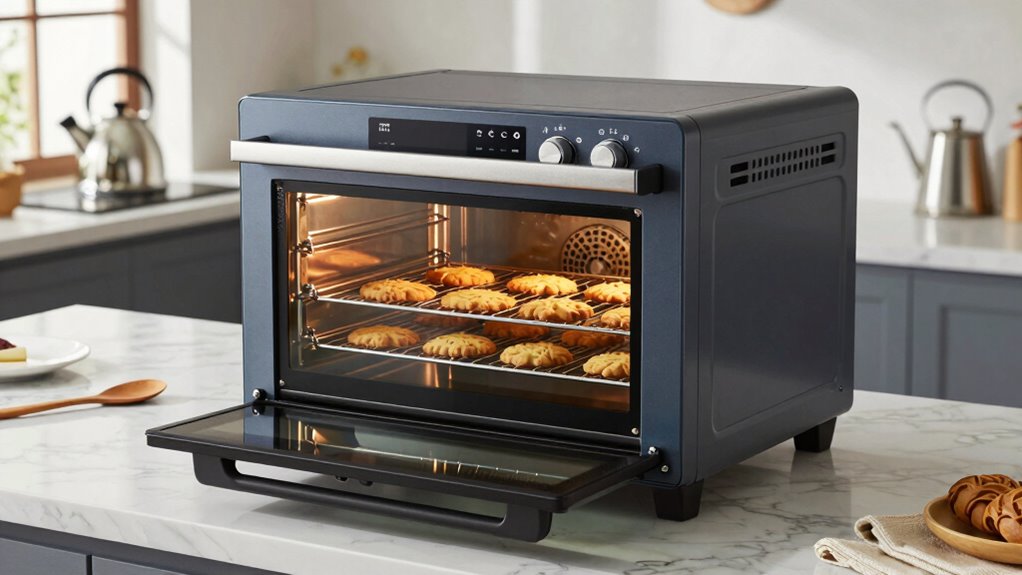

To get more even results from your countertop oven, make sure you preheat thoroughly and allow it to stabilize before cooking. Place food in the center of the oven and avoid overcrowding to improve airflow. Use tools like baking stones or heavy-duty sheets to promote heat distribution, and rotate or flip your food halfway through. Utilizing convection features and proper positioning can help prevent hot spots. Keep exploring for more tips to perfect your baking results.

Get your next haul delivered free with Prime
- Fast, free delivery on millions of items
- Prime Video, Amazon Music and more included
- Member-only deals all year
Key Takeaways
- Preheat the oven thoroughly and allow it to stabilize before cooking.
- Use a baking stone or heavy-duty sheet to promote even heat distribution.
- Rotate or flip food halfway through cooking for uniform exposure.
- Utilize convection settings to improve hot air circulation and browning.
- Monitor actual temperature with an oven thermometer and adjust as needed.
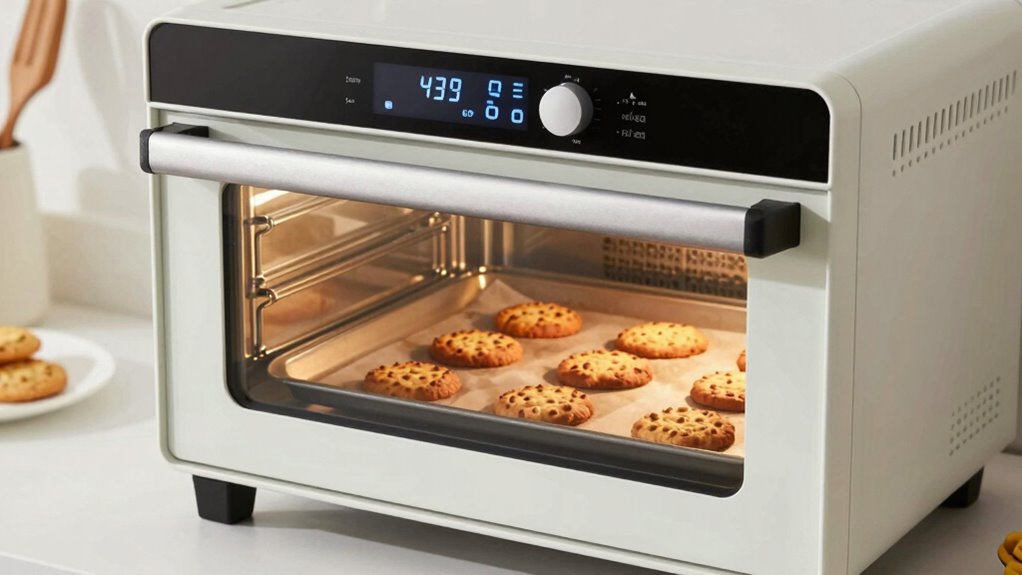
Countertop ovens are convenient, but uneven cooking can be frustrating. Whether you’re trying to perfect a roast or get those cookies just right, inconsistent heat distribution can throw off your results. To improve your baking consistency and get more even results, you need to understand how your oven works and make a few simple adjustments. One effective way to enhance your cooking is by leveraging indoor grilling techniques, which can help distribute heat more uniformly and add a crispy, grilled finish to your dishes. This method can be especially useful when you’re cooking meats or vegetables, ensuring they cook evenly without burning on the outside.
Start by positioning your food properly. Place your tray or rack in the center of the oven, where heat is typically more balanced. Avoid overcrowding, as this can block airflow and create hot spots. If your oven has multiple racks, switch their positions during cooking to promote even heat exposure. Using a good-quality oven thermometer can also help you monitor the actual temperature inside, since the built-in thermostat may not be perfectly accurate. Adjust your oven’s temperature accordingly to maintain a steady, consistent heat throughout your cooking process.
Position food in the oven’s center, switch rack positions, and use a thermometer to ensure consistent, even cooking.
Preheating the oven thoroughly is vital for consistent results. Don’t just turn it on and start cooking immediately; let it reach the desired temperature and stabilize for at least 10-15 minutes. This practice helps eliminate temperature fluctuations that can cause uneven baking. When baking, consider using a baking stone or a heavy-duty baking sheet; these can help distribute heat more evenly across your food, reducing the chances of hot spots. For certain dishes like bread or pizza, the stone acts as a heat reservoir, improving overall baking consistency. Additionally, understanding how heat distribution works within your countertop oven can help you better optimize your cooking techniques. Recognizing the limitations of countertop oven heat dispersion allows you to adapt your methods for better results.
Another tip is to rotate your food midway through the cooking process. If you’re baking cookies or roasting vegetables, turn or flip them to ensure all sides are exposed to similar heat levels. This is especially important in countertop ovens where heat may not be as evenly dispersed as in traditional ovens. Additionally, make use of the oven’s convection feature if it has one. The convection setting circulates hot air around your food, promoting uniform cooking and browning. Just remember to lower the temperature slightly when using convection, as it can cook faster.
Incorporating indoor grilling techniques like using a grill pan or broiler element can enhance flavor and improve browning, but they also help with even heat distribution. By paying attention to positioning, preheating, and utilizing features like convection, you’ll find that your countertop oven can deliver more consistent, delicious results every time.
oven thermometer for countertop oven
As an affiliate, we earn on qualifying purchases.
As an affiliate, we earn on qualifying purchases.
Frequently Asked Questions
Can Adjusting Oven Racks Improve Cooking Evenness?
Yes, adjusting oven racks can improve cooking evenness. Proper rack positioning guarantees better heat distribution and allows oven airflow to circulate evenly around your food. By placing racks strategically, you prevent hot spots and promote uniform cooking. Keep in mind that positioning your food at the center or higher up often enhances airflow, helping your dishes cook consistently. Experiment with rack placement to find the best setup for your specific oven and recipes.
Do Different Cookware Materials Affect Oven Heat Distribution?
Different cookware materials markedly impact oven heat distribution. While metal pans like aluminum and stainless steel heat quickly and promote even cooking, ceramic and glass cookware often retain heat longer, creating hot spots. Your choice affects heat retention effects and cookware compatibility, influencing overall results. Using the right material helps balance heat flow, ensuring your dishes cook evenly. So, select cookware suited for your oven’s heat dynamics for better, more consistent outcomes.
How Does Preheating Influence Cooking Consistency?
Preheating plays a vital role in cooking consistency by creating a Preheat impact that helps stabilize the oven’s temperature. When you preheat your countertop oven, it reaches an even, stable temperature faster, reducing hot spots and uneven cooking. This process guarantees your food cooks evenly and consistently, as the oven maintains better temperature stability throughout the cooking process. Skipping preheating can lead to unpredictable results and unevenly cooked dishes.
Are There Specific Settings for Different Food Types?
When it comes to food preparation, using specific oven settings for different food types can make all the difference. Always check your oven’s manual for recommended temperature and time settings, and adapt based on the dish. Regular oven maintenance guarantees even heat distribution, preventing hot spots. Think of it as giving your oven a tune-up; it’ll perform better and help you achieve consistent, delicious results every time.
How Often Should I Calibrate My Countertop Oven?
You should calibrate your countertop oven at least once every six months, or if you notice uneven cooking or inconsistent oven temperature. To do this, use an oven thermometer to check the actual temperature and compare it to your setting. Adjust the oven’s calibration if needed, ensuring your baking duration and oven temperature are accurate. Regular calibration helps you achieve more even results and better control over your cooking.
baking stone for even heat distribution
As an affiliate, we earn on qualifying purchases.
As an affiliate, we earn on qualifying purchases.
Conclusion
To get more even results from your countertop oven, focus on proper placement, use of tools, and consistent habits. Keep your oven clean, rotate your food, and monitor cooking times closely. By paying attention to these details, you’ll improve your cooking, achieve better results, and enjoy delicious meals every time. Consistency, patience, and care make all the difference—so stay attentive, stay proactive, and let your countertop oven work its best for you.
As an affiliate, we earn on qualifying purchases.
As an affiliate, we earn on qualifying purchases.
Halloween Picks
halloween
As an affiliate, we earn on qualifying purchases.