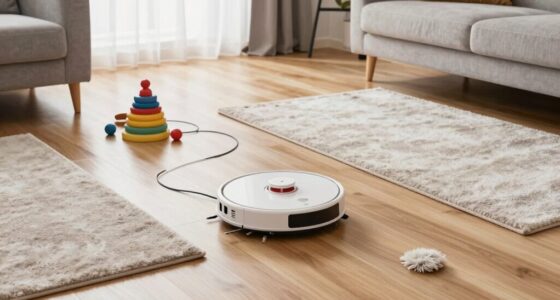

If your floors are cluttered, uneven, or have tight corners, a LiDAR-based robot vacuum is likely your best choice since it creates detailed 3D maps to navigate complex spaces accurately. For open, well-lit areas with fewer obstacles, camera navigation can recognize objects and clean effectively. Understanding your environment helps determine the right option — explore further to see which system suits your floors best and how recent advancements can enhance your cleaning experience.

Get your next haul delivered free with Prime
- Fast, free delivery on millions of items
- Prime Video, Amazon Music and more included
- Member-only deals all year
Key Takeaways
- Use LiDAR for cluttered, irregular, or uneven floors to ensure precise mapping and obstacle avoidance.
- Choose camera-based navigation for open, well-lit spaces with clear visual features.
- LiDAR maintains accuracy in low-light or dark environments, ideal for complex layouts.
- Cameras excel in environments with good lighting and require visual recognition of objects.
- Combining both technologies can enhance overall navigation and cleaning efficiency.
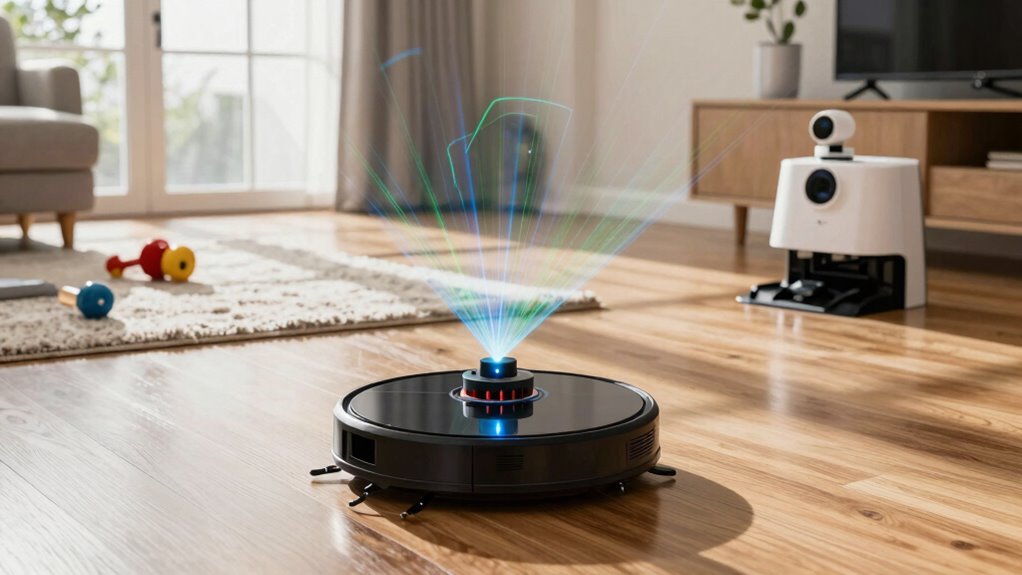
When it comes to autonomous navigation, choosing between LiDAR and camera systems can considerably impact a vehicle’s ability to perceive its environment accurately. This technology creates detailed, three-dimensional maps of your floors, enabling the robot to navigate complex layouts with minimal errors. Its ability to detect obstacles with high accuracy means it can identify small objects, furniture edges, or sudden changes in surface levels, reducing the chances of collisions or missed spots. Because of this, LiDAR-equipped vacuums typically excel in environments with clutter or irregular layouts, ensuring thorough cleaning without getting stuck or missing areas.
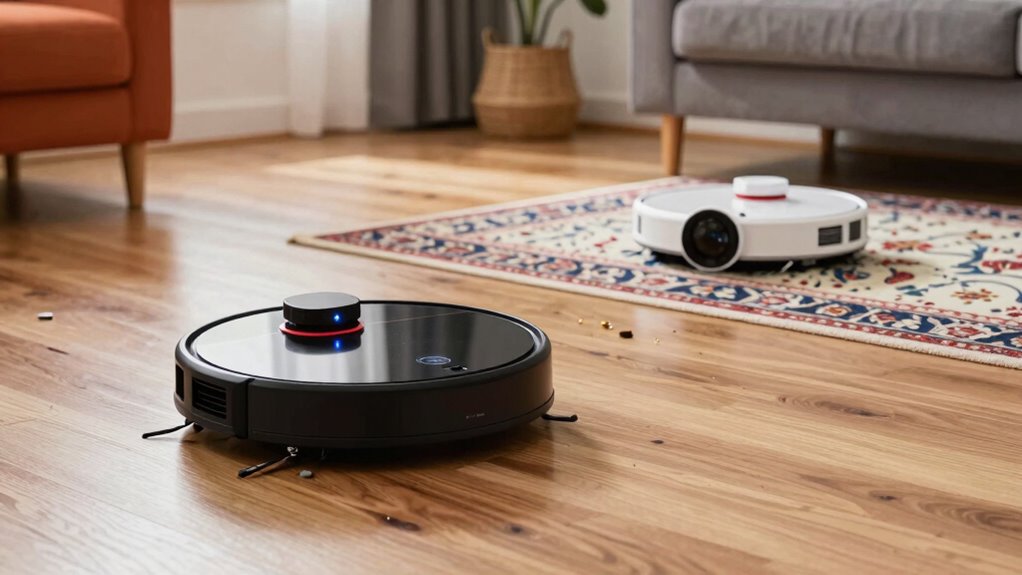
On the other hand, camera-based navigation relies on visual data captured through sensors or cameras mounted on the device. Cameras provide rich contextual information, which can be used to recognize specific features, such as walls, furniture, or even the type of surface. While cameras can be quite effective in open, well-lit spaces, their mapping accuracy can sometimes lag in poorly lit or cluttered areas. This is because cameras depend heavily on lighting conditions and may struggle to differentiate objects in shadows or low-light situations. However, they excel at obstacle detection in clear, well-illuminated environments, giving the robot a good sense of its surroundings through visual cues. Cameras can also enable more advanced features like recognizing and avoiding certain objects or navigating based on visual landmarks, which can be enhanced by visual recognition technology. Understanding these differences can help you choose the right technology for your specific space. Additionally, advancements in sensor integration are continuously improving the capabilities of both systems, making the decision even more nuanced. Incorporating real-time data processing further boosts their effectiveness by allowing quicker adaptations to changing environments. Moreover, the integration of AI and machine learning is helping these systems become smarter and more adaptable over time.
Ultimately, your choice depends on your floor type and cleaning needs. If you have a home with many obstacles, tight corners, or uneven surfaces, a robot vacuum with LiDAR might serve you better by providing precise mapping and reliable obstacle detection. This ensures comprehensive coverage and minimizes the risk of accidents. Conversely, if your space is open, well-lit, and you prefer a device that can recognize specific objects or adapt to visual cues, a camera-based system could be more suitable. Both technologies have their strengths, but understanding how they influence mapping accuracy and obstacle detection helps you make an informed decision. Whether you prioritize detailed navigation or visual recognition, selecting the right system can significantly enhance your cleaning experience, keeping your floors spotless and your robot operating smoothly.
As an affiliate, we earn on qualifying purchases.
Frequently Asked Questions
How Do Lidar and Camera Sensors Perform in Low-Light Conditions?
In low-light conditions, lidar sensors generally outperform camera sensors because their accuracy isn’t affected by lighting. You’ll find lidar maintains consistent sensor accuracy, helping your robot vacuum navigate efficiently in darkness. Conversely, camera sensors struggle in poor lighting, reducing accuracy and potentially causing navigation issues. So, if you often vacuum in dim or dark areas, a lidar-based system might be the better choice for reliable performance regardless of lighting conditions.
Which Navigation System Is More Cost-Effective Long-Term?
You’ll find that lidar navigation is the clear winner in long-term cost-effectiveness. Its cost comparison with camera systems is often surprisingly favorable, especially considering its durability and precision. Plus, lidar requires minimal maintenance, saving you both money and hassle over time. While the initial investment might seem higher, its reliability and lower upkeep mean you’ll save considerably in the long run, making it the smarter choice for your budget.
Can Lidar or Camera Systems Detect Small or Hidden Objects?
Lidar systems are generally better at obstacle detection and object recognition, especially for small or hidden objects, thanks to their precise laser scanning. Cameras can sometimes miss tiny or obscured items, but they excel at identifying objects based on visual cues. If avoiding small or hidden objects is a priority, a robot vacuum with lidar offers more reliable obstacle detection and better overall navigation, reducing the risk of missed spots or collisions.
How Do Navigation Systems Impact Battery Life and Cleaning Efficiency?
Navigation systems directly impact your robot vacuum’s battery life and cleaning efficiency. More advanced sensors, like lidar or cameras, often require more power, which can reduce battery optimization. However, they improve cleaning accuracy and coverage. Durability of sensors also matters—robust sensors last longer and maintain efficiency over time. So, choosing a system with durable sensors and smart power management helps maximize cleaning performance without draining your battery quickly.
Are There Environmental Factors That Affect Lidar or Camera Accuracy?
Environmental factors strongly influence sensor accuracy; studies show dust or fog can diminish lidar effectiveness by up to 50%. You’ll want to contemplate sensor durability, especially if your home has high humidity or pet hair, as these can cause environmental interference. Cameras are sensitive to lighting changes, while lidar struggles in fog or heavy dust. Evaluating your environment helps you choose the right robot vacuum with reliable navigation.
As an affiliate, we earn on qualifying purchases.
Conclusion
In the battle of lidar versus camera navigation, the choice ultimately depends on your home’s needs. Think of lidar as the trusty torchbearer, illuminating every corner with precision, while cameras are like the keen-eyed hawk, spotting details from afar. Just like the brave knights of yore relied on their trusty steeds, pick the system that best suits your floors. Whether you’re in the age of chivalry or the modern era, your perfect robot vacuum awaits!
robot vacuum with obstacle avoidance
As an affiliate, we earn on qualifying purchases.
As an affiliate, we earn on qualifying purchases.
best robot vacuum for cluttered floors
As an affiliate, we earn on qualifying purchases.
As an affiliate, we earn on qualifying purchases.
Fall Picks
fall essentials
As an affiliate, we earn on qualifying purchases.