
Cordless vacuum runtime numbers can be misleading because they’re usually based on ideal, controlled testing conditions that don’t reflect real-world use. When you switch to higher power modes, use attachments, or clean larger areas, your battery will drain faster than advertised. Noise levels and battery degradation over time also impact actual runtime. If you want to better understand what to expect from your vacuum, keep exploring how various factors influence performance day-to-day.

Get your next haul delivered free — and shop member deals
- Fast, free delivery on millions of items
- Access to Prime Big Deal Days deals on October 6–7
- Prime Video, Amazon Music and more included
Key Takeaways
- Advertised runtimes are based on ideal conditions, often exceeding real-world performance.
- High-power modes and attachments quickly reduce actual battery life.
- Battery capacity declines over time, shortening effective runtime regardless of initial specs.
- Noise levels can influence perceived runtime, with quieter models often running shorter.
- Diverse cleaning tasks demand varying power, making standardized figures unreliable for real use.

Ever wondered how long your cordless vacuum can run before needing a recharge? It’s a common question, especially when shopping for a new model or trying to plan your cleaning routine. Manufacturers often highlight impressive runtime numbers, but those figures can be misleading if you don’t understand what’s behind them. Many of these numbers are based on ideal conditions that rarely match real-world use, so you might find your vacuum’s actual runtime considerably shorter.
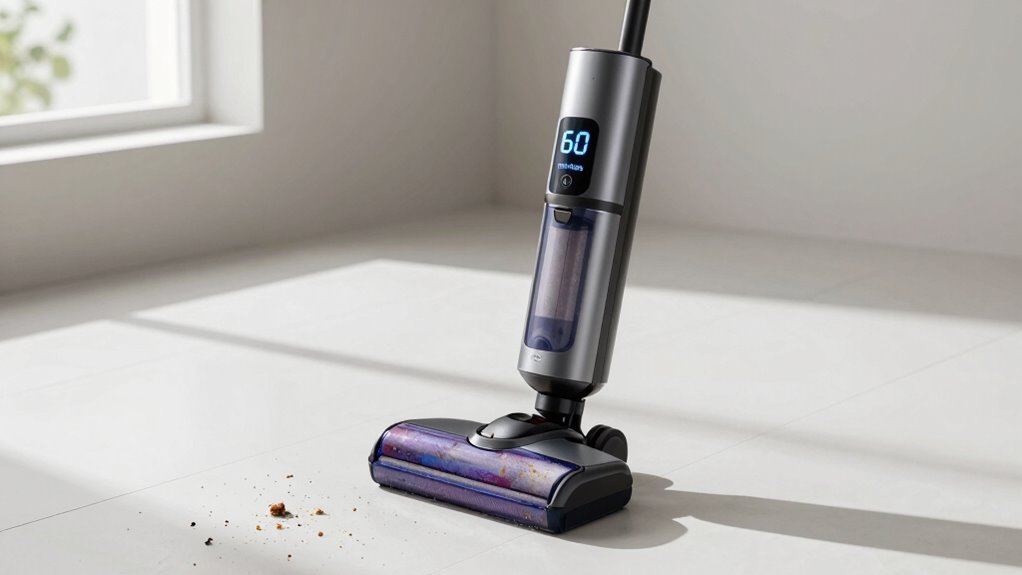
Battery technology plays a essential role in these discrepancies. Most cordless vacuums use lithium-ion batteries, which are praised for their energy density and longevity. However, the advertised runtimes usually assume the vacuum is operating at its lowest power setting with no attachments or obstructions. In practice, when you turn on the turbo or high-suction modes—for stubborn dirt or heavy carpets—the battery drains much faster. So, that 60-minute claim might shrink to 15 or 20 minutes in real cleaning situations. Additionally, batteries degrade over time, meaning your vacuum’s runtime can decrease after months of use, regardless of the initial specs.
Another often-overlooked factor that influences perceived runtime is noise levels. Some vacuums generate less noise because they operate more quietly at lower power settings, which might suggest longer runtimes. But quieter models often compromise on suction power or have limited battery capacity to keep noise levels down, leading to shorter actual cleaning sessions. Conversely, louder vacuums with more robust motors might run for slightly longer because they use more power efficiently, but the noise can be a deterrent if you’re sensitive to sound. Furthermore, noise levels are often linked to motor design, which impacts both performance and battery consumption. Understanding how battery capacity varies among models can help you select a vacuum that balances runtime and performance.
Manufacturers tend to provide runtime figures based on standardized testing methods that don’t account for the variety of tasks you perform daily. For example, cleaning large areas, tackling pet hair, or cleaning carpets all demand different power levels, which directly impact how long the vacuum lasts. If you’re comparing models solely by their advertised run times, you’ll likely overlook these essential differences. Recognizing how battery technology impacts performance can help you set realistic expectations for your cleaning sessions. Furthermore, understanding the power consumption patterns of different models can help you choose a vacuum that better suits your specific cleaning needs.
In essence, the numbers you see on product labels are best viewed as rough estimates under controlled conditions. They don’t necessarily reflect what you’ll experience during typical cleaning sessions. To make a smarter choice, consider how the vacuum performs at various power levels, how its battery technology affects longevity, and how noise levels might influence your comfort. Recognizing these factors will help you understand why those impressive runtime figures can sometimes be more marketing hype than practical reality.
As an affiliate, we earn on qualifying purchases.
Frequently Asked Questions
How Does Battery Age Affect Runtime?
Battery age directly impacts your vacuum’s runtime because as it ages, battery degradation reduces overall capacity, meaning it can’t hold a charge as well. This leads to shorter cleaning sessions. Additionally, voltage stability declines over time, causing inconsistent power delivery. So, even if your vacuum’s original runtime was impressive, an older battery will likely cut that time short, making replacements or maintenance essential for peak performance.
Do Runtime Numbers Vary Between Different Brands?
Yes, runtime numbers vary between brands because of differences in battery capacity and how they manage charging cycles. You might see a vacuum with a higher advertised runtime, but if its battery capacity is smaller or it undergoes more charging cycles, it could perform worse over time. Just like comparing a marathon runner to a sprinter, look beyond the numbers and consider the quality of the battery’s capacity and longevity for real-world performance.
Is Longer Runtime Always Better?
Longer runtime isn’t always better because it depends on factors like battery capacity and charging efficiency. A vacuum with a higher battery capacity may last longer, but if it charges slowly or drains quickly under heavy use, your experience suffers. You should consider how efficiently the vacuum uses its power, not just the raw runtime number. Sometimes, a shorter runtime with faster charging is more practical for your cleaning needs.
How Do Usage Patterns Impact Actual Runtime?
Your usage patterns greatly impact actual runtime, even if the battery capacity suggests otherwise. Ironically, the more you use your vacuum, the less runtime you get—because user habits like frequent shifts between high and low power modes drain the battery faster. Heavy-duty cleaning or continuous use shortens your vacuum’s effective runtime, proving that real-world use often defies the advertised battery life, no matter its capacity.
Can Charger Quality Influence Runtime Performance?
Yes, charger quality can influence your vacuum’s runtime performance. A high-quality charger offers better charging speed, which helps your battery reach full capacity faster and maintain ideal performance. It also guarantees safe, efficient charging, preserving your battery’s capacity over time. Poor-quality chargers may deliver inconsistent power, reducing battery life and runtime. So, investing in a good charger helps maximize your vacuum’s runtime and overall efficiency.
best battery life cordless vacuum
As an affiliate, we earn on qualifying purchases.
As an affiliate, we earn on qualifying purchases.
Conclusion
So, next time you’re dazzled by that shiny “60-minute runtime” on a cordless vacuum, remember: it’s probably more of a “let’s pretend” estimate. Don’t be fooled into thinking you’ll clean the entire house in one go. In truth, those numbers are as reliable as a cat’s promise to stay off the sofa. So, embrace the chaos, grab some extra batteries, and prepare for your cleaning marathon — or at least a quick sprint.
cordless vacuum with long battery life
As an affiliate, we earn on qualifying purchases.
As an affiliate, we earn on qualifying purchases.
As an affiliate, we earn on qualifying purchases.
Halloween Picks
halloween
As an affiliate, we earn on qualifying purchases.