
TL;DR

Get your next haul delivered free — and shop member deals
- Fast, free delivery on millions of items
- Access to Prime Big Deal Days deals on October 6–7
- Prime Video, Amazon Music and more included
Building your own AI workstation used to save money, but recent component shortages and price spikes mean prebuilt systems often cost about the same or less. Your choice depends on your need for control, speed, and support, not just savings.
Imagine you’re ready to run your first deep learning model locally. Do you build a machine from scratch or buy one ready-made? For years, the answer was simple: build to save money, buy to save time. But in 2026, that rule no longer applies.
The AI boom, chip shortages, and skyrocketing component prices have shifted the landscape. Now, the real question is whether you want control and customization or speed and support. This article breaks down the true costs, performance differences, and support options, so you can decide what suits your project best.
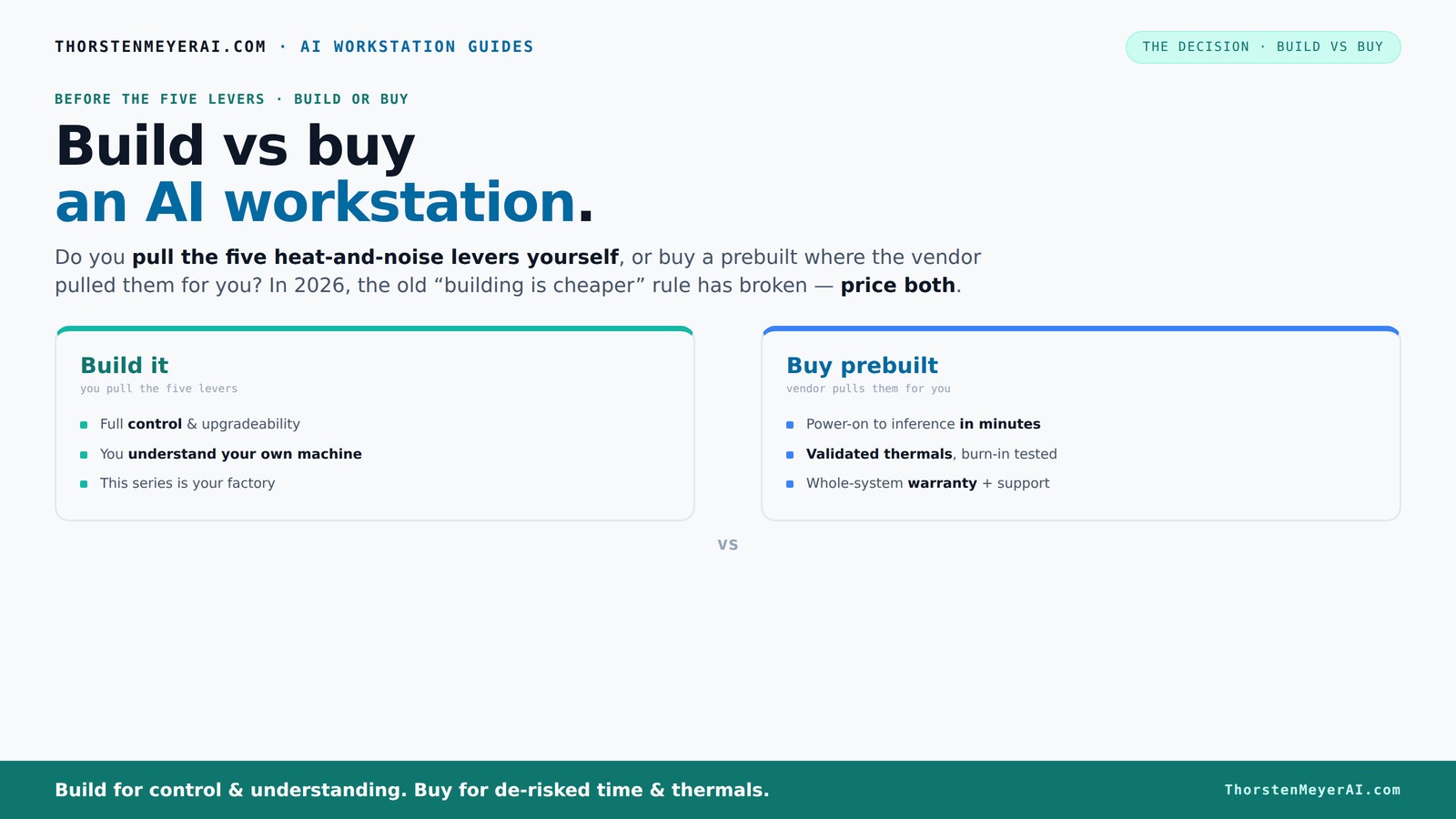
Build vs buy
an AI workstation.
The real question behind this whole series: do you pull the five heat-and-noise levers yourself, or buy a prebuilt where the vendor pulled them for you? And in 2026, the old “building is cheaper” rule has broken. Match your situation in Part 3.
Key Takeaways
- Component shortages and bulk purchasing have made prebuilt systems often as affordable as DIY builds in 2026.
- Validated thermals and manufacturer testing in prebuilt systems can save hours of troubleshooting and reduce risk during heavy workloads.
- Speed of deployment is critical—prebuilts get you up and running faster, especially when deadlines loom.
- Support and warranties in prebuilt systems offer peace of mind, especially for critical or long-term projects.
- Choose building if you need full control, customization, or enjoy the process; opt for buying if time, support, and reliability matter most.
As an affiliate, we earn on qualifying purchases.
Why the Cost of Building Isn't Always Cheaper Anymore
Building your own AI workstation used to be the budget-conscious choice. Today, it’s more complicated. Component shortages and bulk buying by big vendors mean prebuilt systems often come at prices that are hard to beat or even match.
For example, a high-end GPU like the NVIDIA RTX 4090 used to cost around $1,200, but now, due to supply chain issues, it can be $1,600 or more. Meanwhile, prebuilt vendors purchase in bulk, offering systems with similar specs at comparable or lower prices. According to [1], a custom build that used to cost $1,000 now easily hits $1,250 or higher.
So, instead of blindly assuming DIY is cheaper, always compare both options. The real cost includes not just parts, but also labor, time, and future upgrades. This means that while the sticker price of parts might seem lower, the value of your time and the potential for costly mistakes or overlooked compatibility issues can tilt the balance. Additionally, the economies of scale that large vendors leverage often allow them to include more advanced cooling, warranty services, and support, which can make prebuilt options more attractive when considering total cost of ownership.
As an affiliate, we earn on qualifying purchases.
How Performance and Compatibility Matter for Your AI Workload
Performance isn't just about raw specs; it’s about how well your system handles sustained AI workloads. Prebuilt systems are validated for thermal stability, cooling, and compatibility. That means no surprises during long training sessions.
When building yourself, you choose each component—GPU, CPU, cooling, case—to optimize for your workload. Learn more about building a media room. But mismatched parts or poor airflow can cause throttling or crashes. For instance, a DIY cooling setup might cool a GPU adequately during initial tests, but under hours of heavy use, temperatures spike, reducing performance.
According to [3], prebuilt systems like those from Lambda or BIZON undergo 24–48 hours of burn-in testing, ensuring thermal stability. This testing is crucial because sustained AI workloads generate significant heat and demand consistent performance. Without proper thermal management, system throttling can occur, which diminishes training speeds and can even cause hardware failures. Choosing a validated system means you’re investing in reliability and predictable performance. Conversely, DIY builds require careful selection and tuning of cooling solutions, which can be time-consuming and complex. The tradeoff is that a DIY system, if properly configured, can be tailored precisely to your workload, but it demands expertise and ongoing maintenance to ensure optimal thermal performance.
As an affiliate, we earn on qualifying purchases.
Speed of Deployment: Why Timing Could Decide Your Choice
If you need to start training or inference yesterday, prebuilt systems is the clear winner. These systems arrive ready with OS, drivers, and AI frameworks installed, letting you plug in and go.
Building takes time—ordering parts, waiting for delivery, assembling, troubleshooting BIOS and driver issues. During shortages, some parts can delay your project by weeks. For example, a typical build might take 1–2 weeks, while a prebuilt can arrive in days.
According to [2], enterprise AI projects often choose prebuilt solutions for faster deployment, especially when deadlines loom. The ability to rapidly deploy a system can be the difference between meeting or missing critical project milestones. If your project has tight deadlines or you need to quickly iterate on experiments, prebuilt systems reduce setup time significantly. On the other hand, building your own system involves procurement delays, assembly, and testing, which can extend timelines. This tradeoff is especially relevant when project timelines are non-negotiable, making prebuilt solutions a strategic choice to ensure timely delivery without sacrificing performance or reliability.
As an affiliate, we earn on qualifying purchases.
Support and Warranty: Your Safety Net in AI Workstations
Prebuilt systems come with vendor warranties, often 3–5 years, plus dedicated support. If your machine crashes during a crucial training run, you call support, and they fix or replace parts quickly.
DIY setups rely on individual component warranties—sometimes just 1 year—and troubleshooting can become a frustrating game of trial and error. If you’re unfamiliar with hardware, fixing a GPU or PSU failure can take hours or days.
For example, Lambda offers a 3-year warranty with on-site repairs, reducing downtime. That peace of mind might be worth the extra cost for many users. The value of support becomes even more significant when your AI workloads are mission-critical or run on tight schedules. Quick access to support and repair services minimizes downtime and prevents costly delays. Conversely, DIY users must often navigate multiple warranties and support channels, which can be time-consuming and stressful, especially if hardware failures occur unexpectedly. For professional environments where uptime is essential, the reliability and prompt support of a prebuilt system can justify the higher initial investment, saving you time and reducing risk of prolonged downtime.
Customization and Future Upgrades: How Much Control Do You Need?
Building your own system gives you full control over every component—GPU count, RAM, storage, cooling, and case design. Want a dual-GPU setup with custom water cooling? You can do that.
Prebuilt systems are more limited but often offer options like adding more RAM or upgrading GPUs later. However, some vendors design their systems with future expansion in mind, with extra PCIe slots or larger PSUs. This planning can significantly extend the lifespan and upgradeability of your machine, especially as AI models grow larger and more demanding.
For instance, a DIYer might start with a single GPU and upgrade to two later, but must ensure the motherboard supports it and cooling can handle the added heat. According to [6], some prebuilt systems are designed to grow with your needs, reducing upgrade friction. The tradeoff is that fully customized builds provide the highest degree of control, enabling you to select specific components tailored to your workload and aesthetic preferences. However, this requires a good understanding of hardware compatibility and future-proofing considerations. Prebuilt systems with modular design or upgrade-friendly features can offer a middle ground, providing some control with less complexity. Choosing between the two depends on your technical expertise, future plans, and whether you value hands-on customization over convenience.
When Buying a Prebuilt Makes Sense
If you’re pressed for time, lack technical skills, or need a reliable, tested system, prebuilt is the way to go. These systems arrive ready with OS, drivers, and AI frameworks installed, letting you start training or inference immediately.
They also come with support and warranties, reducing your risk of hardware failure during critical runs. For example, Lambda’s validated systems are built with thermal and noise optimization, saving you the hassle of tuning.
Plus, if your workload is complex—multi-GPU training or high-end inference—vendors have the expertise to deliver a system that works out of the box. The convenience and reliability of prebuilt systems can translate into faster project launches and fewer technical setbacks, especially for teams without extensive hardware expertise or when time is of the essence.
When Building Your Own AI Workstation Is Better
If you crave control, want to customize down to the last detail, or aim to optimize for specific workloads, DIY is still appealing. You can select the exact GPU model, cooling method, and case to match your needs.
Plus, if you’re comfortable with hardware and enjoy the building process, DIY offers a sense of ownership and learning. For example, undervolting your GPU can reduce heat and noise, boosting performance and longevity.
However, remember that building requires time, patience, and troubleshooting skills—so it’s best suited for tech enthusiasts or those with flexible timelines. The ability to fine-tune each component and understand the hardware intricacies can lead to a system perfectly aligned with your unique requirements, but only if you have the expertise and patience to navigate the complexities involved.
Frequently Asked Questions
Is it cheaper to build or buy an AI workstation in 2026?
Component shortages and bulk buying have closed the price gap. Often, prebuilt systems cost the same or less than DIY builds today. Always compare specific configurations before deciding.
How much performance do I lose with a prebuilt system?
Most validated prebuilts are tuned for thermal performance and stability, often matching or exceeding DIY setups. They undergo burn-in testing, reducing the risk of throttling during long runs.
Can I upgrade a prebuilt workstation later?
Yes, many prebuilt systems support upgrades like adding RAM or GPUs, but check the design—some have limited PCIe slots or smaller power supplies. Building gives you more flexibility but requires more planning.
What specs do I need for AI training versus inference?
Training benefits from higher VRAM and multiple GPUs, while inference can often run well on a single GPU with less VRAM. Tailor your build or buy to your workload—check [4] for detailed GPU choices.
Is warranty support worth the extra cost?
For critical projects or heavy workloads, vendor support reduces downtime and fixes hardware issues swiftly. If you’re a hobbyist or experienced builder, DIY might suffice, but support can be a lifesaver during emergencies.
Conclusion
In the end, the choice hinges on your priorities. Do you want total control and the satisfaction of building your perfect machine, or do you prefer speed, support, and peace of mind? In 2026, the smart move is to compare both options carefully—costs, timelines, and support can surprise you.
Remember, your AI journey is a marathon, not a sprint. Whichever route you choose, make sure it aligns with your goals and resources. The right system can be your trusted partner in pushing the boundaries of what’s possible.
Fall Picks
fall essentials
As an affiliate, we earn on qualifying purchases.