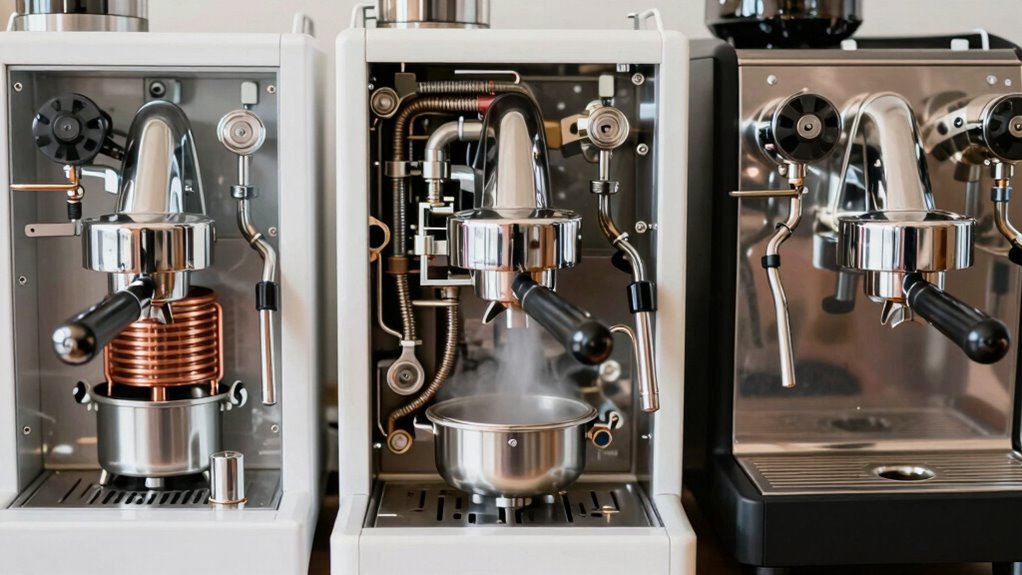
When choosing between a single boiler, heat exchanger, and dual boiler espresso machine, consider your workflow needs and budget. A single boiler is compact and affordable but requires waiting between brewing and steaming. A heat exchanger offers a good balance, allowing simultaneous brewing and steaming with stable temperatures. Dual boilers provide maximum control, speed, and consistency for busy or serious coffee enthusiasts. Keep exploring to understand which option suits your brewing style best.
Key Takeaways
- Single boilers combine brewing and steaming in one chamber, requiring temperature adjustments or waiting, while heat exchangers allow simultaneous operations without switching modes.
- Dual boilers offer dedicated, stable temperatures for both brewing and steaming, providing maximum consistency and efficiency.
- Single boilers are more affordable and compact, ideal for home use, whereas dual boilers are larger and suited for high-volume environments.
- Heat exchangers balance performance and cost, enabling simultaneous brewing and steaming with decent steam capacity.
- The choice depends on workflow needs, budget, and desired consistency, with dual boilers offering the highest control and speed.
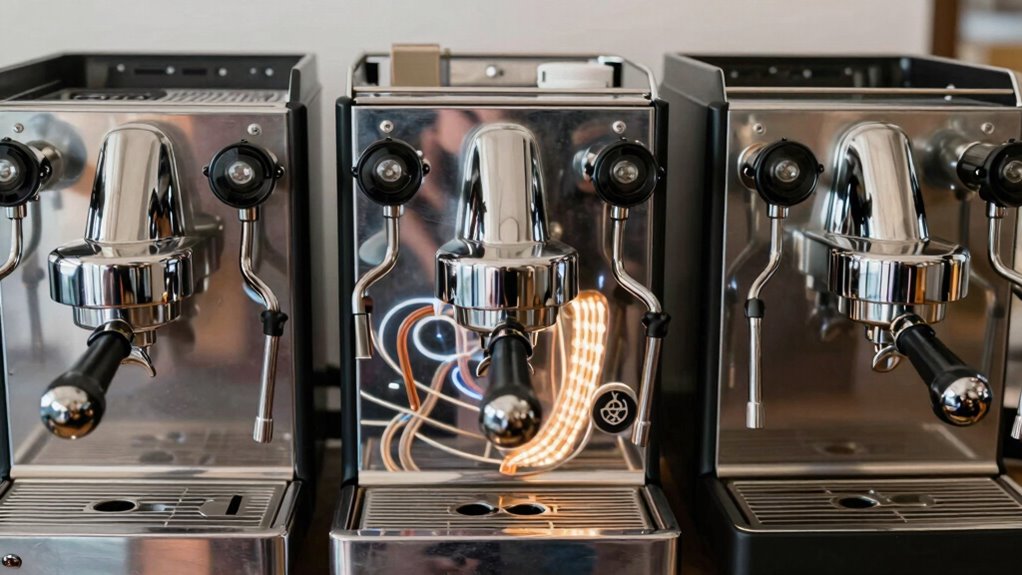
Choosing the right espresso machine can be challenging, especially when comparing single boiler, heat exchanger, and dual boiler systems. Each type offers distinct advantages and limitations, so understanding how they handle brew temperature and steam capacity is essential. Your decision hinges on how you prioritize these factors for your coffee experience.
Choosing the right espresso machine depends on your priorities for brew temperature stability and steam capacity.
A single boiler machine is straightforward and typically more affordable. It heats water in one chamber, so when you pull a shot of espresso, the boiler must be at the ideal brew temperature, usually around 200°F. After brewing, you need to wait for the boiler to cool slightly if you want to produce steam, which means you can’t brew coffee and steam milk simultaneously. This limitation affects your workflow, especially if you make multiple drinks in succession. The brew temperature remains stable during extraction, but because the boiler is shared, steam capacity is limited. You’ll find that these machines are best suited for home use or occasional brewing, where speed isn’t critical.
Heat exchanger machines introduce a clever solution. They contain a single boiler that’s maintained at a higher temperature, often around 250°F, with a metal pipe (the heat exchanger) running through it. This setup allows water to be diverted for brewing at the ideal temperature while the boiler produces steam simultaneously. The brew temperature stays consistent, ensuring your espresso extraction is stable, and you can pull shots while steaming milk without waiting. The steam capacity of heat exchangers is usually decent, enough for multiple milk-based drinks, but it might struggle during heavy use or if you need to make many drinks back-to-back. They’re a good middle ground, offering better workflow without the complexity and cost of dual boilers. Additionally, advancements in energy-efficient technology are making these machines more sustainable and cost-effective over time.
Dual boiler machines provide the most flexibility. They have separate boilers—one dedicated to brewing and another solely for steaming. This setup ensures consistent brew temperature, often precisely maintained, and ample steam capacity for simultaneous milk frothing and espresso extraction. You don’t need to wait between steaming and brewing, making them ideal for busy environments or serious enthusiasts. The trade-off is cost and size; dual boilers are typically more expensive and larger, but they deliver unmatched control and speed. If you frequently prepare multiple drinks or want maximum consistency, dual boiler machines give you the flexibility and performance you need.

Breville Barista Express Espresso Machine BES870XL, Brushed Stainless Steel
The Breville Barista Express delivers third wave specialty coffee at home using the 4 keys formula and is…
As an affiliate, we earn on qualifying purchases.
As an affiliate, we earn on qualifying purchases.
Frequently Asked Questions
Which Machine Is Best for Beginner Baristas?
For beginner baristas, a single boiler machine is your best choice. It’s compact, affordable, and simple to operate, making it perfect for learning. You’ll find it easier to manage due to its smaller size and lower price compared to heat exchanger or dual boiler machines. While it may have limitations, it provides a solid foundation for developing your skills before moving on to more advanced equipment.
How Does Temperature Stability Vary Among the Types?
Imagine your espresso machine as a steady heartbeat—each type offers different rhythms. Single boilers struggle with temperature consistency, often fluctuating as they heat and cool. Heat exchangers maintain better temperature stability by rapidly switching between brewing and steaming, like a metronome. Dual boilers excel in heat retention, providing consistent temps for both functions simultaneously. So, if you crave precise temperature stability, dual boilers are your best bet.
Can I Upgrade My Espresso Machine Later?
Yes, you can typically upgrade your espresso machine later, but it depends on the model and its design. Some machines are built for future modifications, allowing you to add features like a PID controller or dual boilers. Research your current machine’s compatibility before planning a machine upgrade, so you know what’s feasible. Keep in mind that upgrades may require technical skills or professional assistance for ideal results.
What Maintenance Is Required for Each System?
You’ll need to keep up with cleaning routines for each system to guarantee optimal performance and flavor. Regular descaling and cleaning of the group head, steam wand, and drip tray prevent buildup. Replacement parts like seals and gaskets may be necessary over time, especially if you notice leaks or reduced efficiency. Staying on top of maintenance not only prolongs your machine’s life but also guarantees consistently great espresso.
Are Dual Boilers More Energy-Efficient Than Others?
Yes, dual boilers are generally more energy-efficient because they allow you to brew and steam simultaneously without heating up again, reducing power consumption. This setup saves energy by maintaining two separate boilers at ideal temperatures, leading to better energy savings over time. Although they might use more power initially, their efficiency in operation can lower overall energy costs, especially if you frequently prepare espresso and steamed milk.

Diletta Bello Espresso Machine | Heat Exchanger | E61 | Manual Control | 3 Liter | Made In Italy | (Stainless Steel)
Italian Made – Each Diletta machine is handcrafted in Milan, Italy.
As an affiliate, we earn on qualifying purchases.
As an affiliate, we earn on qualifying purchases.
Conclusion
Choosing between a single boiler, heat exchanger, or dual boiler depends on your brewing needs. Did you know that dual boilers can heat water and steam simultaneously, allowing for quicker, more efficient espresso pulls? This setup is perfect for busy cafes or serious enthusiasts. Understanding these differences helps you make an informed decision, ensuring you get the best performance for your daily brew. Ultimately, selecting the right system elevates your espresso game and saves you time.
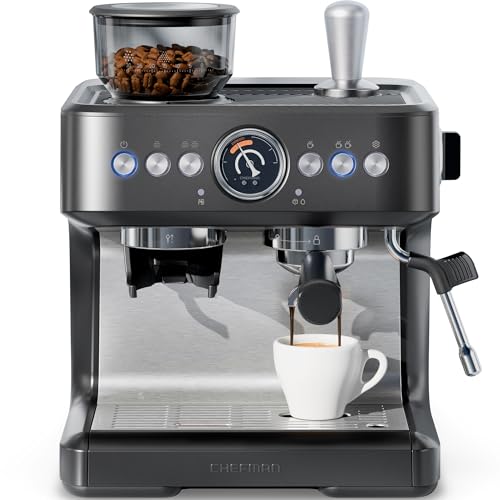
Chefman Crema Deluxe Espresso Machine with Double Boiler, Use Milk Frother and Brew Espresso Simultaneously, Professional Coffee Maker with Coffee Grinder and Steam Wand, 30 Grind Settings
BARISTA-LEVEL ESPRESSO AT HOME: Brew rich, café-quality espresso with a semi-automatic design that grinds, brews, and delivers full…
As an affiliate, we earn on qualifying purchases.
As an affiliate, we earn on qualifying purchases.
Chefman Crema Deluxe Espresso Machine with Double Boiler, Use Milk Frother and Brew Espresso Simultaneously, Professional Coffee Maker with Coffee Grinder and Steam Wand, 30 Grind Settings
BARISTA-LEVEL ESPRESSO AT HOME: Brew rich, café-quality espresso with a semi-automatic design that grinds, brews, and delivers full…
As an affiliate, we earn on qualifying purchases.
As an affiliate, we earn on qualifying purchases.