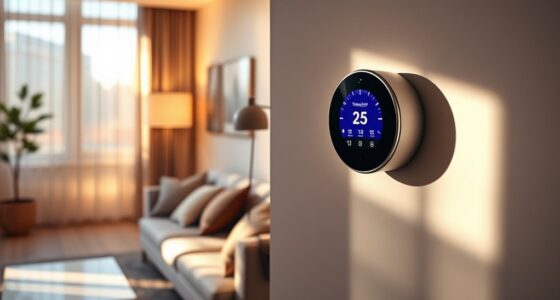

Circadian lighting automates the adjustment of your home’s light color and brightness to mimic natural daylight patterns. During the day, it provides bright, blue-enriched light that boosts alertness, while in the evening, it shifts to warmer tones that help you wind down. This system aligns your indoor environment with your body’s natural rhythms, improving sleep and overall well-being. Keep exploring to discover how you can optimize your lighting for better health and comfort.

Get your next haul delivered free with Prime
- Fast, free delivery on millions of items
- Prime Video, Amazon Music and more included
- Member-only deals all year
Key Takeaways
- Use smart lighting systems that adjust color temperature and brightness according to the time of day.
- Automate lighting schedules to mimic natural daylight patterns, supporting your circadian rhythm.
- Program lights to emit blue-enriched light during the day and warmer tones in the evening.
- Integrate motion sensors and timers for seamless, personalized lighting adjustments.
- Leverage apps and automation platforms to customize lighting environments for optimal alertness and sleep.
Have you ever wondered how lighting affects your body’s internal clock? It’s a fascinating connection that can influence your energy levels, mood, and overall health. One of the key players in this relationship is blue light, a specific type of light that naturally occurs during daylight hours. Blue light helps regulate your sleep cycle by signaling your brain that it’s daytime, boosting alertness and keeping you awake. However, exposure to blue light isn’t limited to the sun; electronic devices like smartphones, tablets, and computer screens emit significant amounts of it. When you spend too much time exposed to blue light, especially late in the evening, it can interfere with your body’s natural rhythm, making it harder to fall asleep and disrupting your sleep cycle.
Understanding how lighting influences your internal clock is essential for maintaining a healthy sleep pattern. Your circadian rhythm, the internal clock that governs your sleep-wake cycle, relies heavily on light cues. During the day, natural sunlight provides bright, blue-enriched light that keeps your internal clock aligned with the 24-hour day. As the sun sets, light levels decrease, and the absence of blue light signals your body to produce melatonin, the hormone responsible for making you sleepy. When artificial lighting or screens emit excessive blue light late into the evening, your brain receives mixed signals. This delay in melatonin production can lead to difficulty falling asleep, reduced sleep quality, and a disrupted circadian rhythm.
Light cues are vital for your circadian rhythm, signaling when to sleep and wake for better health and rest.
This is where circadian lighting systems come into play. These innovative lighting solutions are designed to mimic natural daylight patterns, adjusting color temperature and brightness throughout the day. By gradually decreasing blue light exposure in the evening, circadian lighting helps your body transition smoothly into sleep mode. During the daytime, these systems deliver bright, blue-enriched light that supports alertness and productivity. As evening approaches, the lighting shifts to warmer, softer tones with less blue light, signaling your body that it’s time to wind down. Automating your lighting in this way creates a more natural environment that aligns with your body’s internal clock, reducing sleep disruptions and enhancing overall well-being. Incorporating smart lighting technology can further optimize these benefits by adapting lighting conditions to your personal schedule.
Incorporating circadian lighting into your daily routine can make a noticeable difference in your sleep quality and daytime energy. When your environment supports your natural rhythms, you’re more likely to wake up feeling refreshed and stay alert throughout the day. You don’t have to overhaul your entire lighting setup overnight; smart, automated systems are available that can adapt to your schedule. By understanding the impact of blue light on your sleep cycle and leveraging circadian lighting solutions, you take control of your environment and support your health in a simple, effective way.
As an affiliate, we earn on qualifying purchases.
Frequently Asked Questions
How Does Circadian Lighting Impact Sleep Quality?
Circadian lighting improves your sleep quality by regulating melatonin production and syncing with your sleep cycle. When exposed to proper light at the right times, your body naturally boosts melatonin at night, helping you fall asleep faster and enjoy deeper rest. During the day, bright, natural light keeps your circadian rhythm synchronized, so your sleep cycle stays consistent. This balance ultimately leads to more restful, restorative sleep.
Can Circadian Lighting Reduce Energy Costs?
Yes, circadian lighting can reduce energy costs by optimizing light usage throughout the day. When you automate your lighting system, it adjusts brightness based on natural daylight, leading to significant energy savings. This enhances cost efficiency, as you use less electricity during peak hours and rely more on natural light. Implementing circadian lighting helps you save money while maintaining a comfortable, healthy environment.
Is Circadian Lighting Suitable for All Age Groups?
Circadian lighting is suitable for most age groups, but you should consider age appropriateness and developmental benefits. For children, it can support healthy growth and sleep patterns, while older adults may experience improved alertness and mood. You’ll find that adjusting light intensity and timing benefits everyone’s circadian rhythm. Be mindful of specific needs, especially for vulnerable groups, to maximize the positive effects on sleep, mood, and overall health.
What Are the Best Placement Tips for Optimal Lighting?
To optimize lighting, prioritize fixture positioning to guarantee even light distribution and minimize shadows. Use adjustable fixtures to target areas where natural light is limited. Choose a color temperature that matches the time of day—cooler for mornings and warmer for evenings—to support your circadian rhythm. Keep fixtures at eye level or slightly above for comfort, and avoid placing lights directly in your line of sight to prevent glare.
How Does Circadian Lighting Integrate With Smart Home Systems?
Think of circadian lighting as the conductor of your smart home orchestra. It seamlessly integrates with your automation systems, ensuring your lights adapt to natural daylight. With high automation compatibility and device interoperability, it syncs effortlessly with smart hubs, voice assistants, and sensors. This means your lighting adjusts automatically, mimicking sunrise and sunset, helping you stay aligned with your body’s natural rhythms without lifting a finger.
smart lighting with adjustable color temperature
As an affiliate, we earn on qualifying purchases.
As an affiliate, we earn on qualifying purchases.
Conclusion
Embrace circadian lighting and let it guide your days like the steady rhythm of the sun. Just as nature’s cycle once dictated life’s tempo, modern automation can restore that harmony, helping you stay energized and balanced. By aligning your indoor environment with your body’s internal clock, you’re not just lighting a room—you’re igniting a symphony of well-being. In doing so, you reclaim a piece of the ancient dance between light and life.
automated daylight mimicking lights
As an affiliate, we earn on qualifying purchases.
As an affiliate, we earn on qualifying purchases.
blue light adjustable smart bulbs
As an affiliate, we earn on qualifying purchases.
As an affiliate, we earn on qualifying purchases.
Fall Picks
fall essentials
As an affiliate, we earn on qualifying purchases.