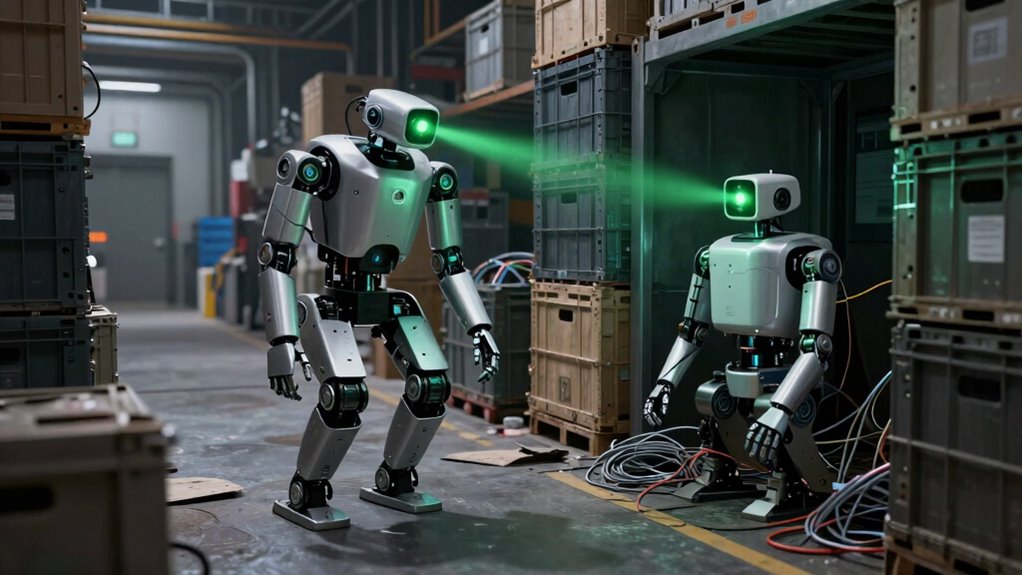

LiDAR and V‑SLAM each have strengths and weaknesses that can cause robots to get lost. LiDAR offers precise distance measurement but struggles with rain, fog, or reflective surfaces. V‑SLAM performs well in textured, well-lit environments but can lose track in poor lighting or featureless areas. Combining these sensors through fusion helps overcome individual limitations, ensuring more reliable navigation. Keep exploring to understand how these technologies work together to keep robots on track.
Key Takeaways
- LiDAR provides precise distance data but can be disrupted by rain, fog, or reflective surfaces, leading to mapping errors.
- V-SLAM relies on visual cues and lighting conditions, making it prone to losing track in poorly lit or visually sparse environments.
- Both systems can struggle in challenging conditions; sensor fusion mitigates these issues by combining data sources.
- Environmental factors like dust, glare, or changing illumination can cause either system to lose accurate localization.
- Understanding each system’s limitations helps in choosing appropriate navigation methods to prevent robots from getting lost.
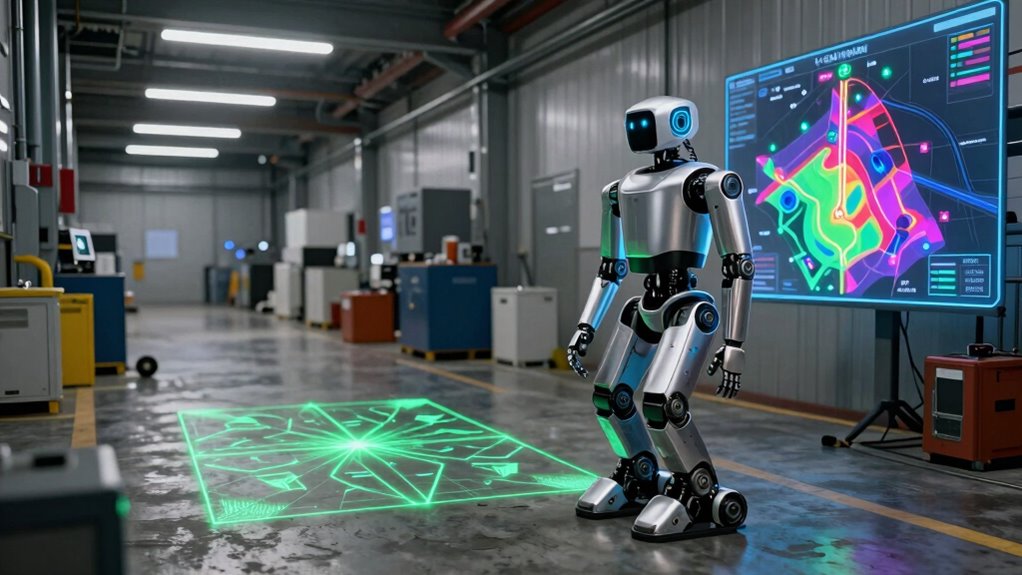
When choosing between LiDAR and V‑SLAM navigation systems, it’s important to understand how each technology works and their respective strengths. Both aim to help robots navigate complex environments, but they approach this goal differently. LiDAR, which uses laser sensors to create detailed 3D maps of surroundings, excels in providing precise spatial data. V‑SLAM, or Visual Simultaneous Localization and Mapping, relies on cameras and computer vision algorithms to build maps while tracking the robot’s position within them. Your choice hinges on understanding how these systems process information and the significance of sensor fusion for achieving reliable navigation and high mapping accuracy.
LiDAR systems generate highly accurate distance measurements, producing point clouds that form the foundation of detailed maps. Because of this, they tend to be less affected by variable lighting conditions, making them reliable in dark or poorly lit environments. However, LiDAR’s effectiveness can be limited by factors like rain, fog, or dust, which scatter laser beams and degrade data quality. V‑SLAM, on the other hand, leverages visual data from cameras, which can be more versatile in environments with rich textures and sufficient lighting. But visual-based systems are often more sensitive to lighting changes, shadows, or visual clutter, which can cause errors in localization and mapping.
Sensor fusion plays a pivotal role in enhancing these systems. By combining data from LiDAR and cameras, you can leverage the strengths of both, boosting mapping accuracy and robustness. For instance, in complex indoor environments where visual cues might be ambiguous, LiDAR can provide reliable spatial measurements, while cameras add context and detail. Conversely, in outdoor settings with variable lighting or weather, sensor fusion helps maintain stable localization. This integrated approach reduces the risk of your robot getting lost because it relies on multiple data sources rather than just one.
Despite their advantages, both systems can face challenges that cause navigation failures. For example, LiDAR might struggle in environments with reflective surfaces, leading to flawed maps, while V‑SLAM can lose track of its position if visual features are sparse or change rapidly. Understanding these limitations highlights why sensor fusion is increasingly becoming the standard in robotics. It improves overall mapping accuracy and navigation stability, preventing your robot from getting lost. Ultimately, your decision should consider the environment, operational conditions, and whether combining sensors through fusion makes sense for your specific application.
Frequently Asked Questions
How Do Environmental Conditions Affect Lidar and V-Slam Accuracy?
Environmental conditions can notably impact both LiDAR and V-SLAM accuracy. You might experience sensor interference from dust, fog, or rain, which disrupts sensor signals. Dynamic obstacles like moving people or vehicles can confuse the system, making it hard to maintain accurate localization. These factors cause errors in mapping and navigation, increasing the risk of losing track of your robot’s position. Proper sensor calibration and adaptive algorithms can help mitigate these issues.
Can Robots Switch Seamlessly Between Lidar and V-Slam Navigation?
You can think of switching between LiDAR and V-SLAM like a sailor shifting sails to catch changing winds. Robots achieve this through sensor fusion, blending data from both systems, and with algorithm adaptability that allows smooth progression. While not always seamless, advancements enable robots to adapt quickly, using the best sensor at any moment, ensuring they stay on course even when environmental conditions shift unexpectedly.
What Are the Cost Differences Between Lidar and V-Slam Systems?
You’ll find that lidar systems tend to be more expensive upfront due to their hardware costs, while V‑SLAM solutions are often more budget-friendly, especially with software-based implementations. When considering cost comparison, think about your budget considerations and the level of accuracy you need. If you require precise mapping and navigation, investing in lidar might be worth it, but for lower-cost setups, V‑SLAM offers a more affordable alternative.
How Do Power Consumption Levels Compare for Both Navigation Methods?
You’ll find that V‑SLAM systems generally consume less energy compared to LiDAR, making them more battery-efficient. V‑SLAM uses camera data and algorithms to map surroundings, which requires less power than LiDAR’s laser scanning. This means your robot’s energy consumption stays lower, extending battery life. If power efficiency is your priority, V‑SLAM offers a more sustainable option, helping your robot operate longer without frequent recharges.
What Are the Maintenance Requirements for Lidar Versus V-Slam?
You’ll find that LiDAR requires regular sensor calibration to maintain accuracy, especially in changing environments, and periodic hardware checks. Software updates are also necessary to improve performance and fix bugs. V-SLAM, on the other hand, mainly needs software updates for better algorithms and occasional calibration of its visual sensors. Overall, LiDAR’s maintenance tends to be more hardware-focused, while V-SLAM relies more on software upkeep.
Conclusion
Think of LiDAR as a lighthouse guiding your robot through foggy waters, while V-SLAM is like a seasoned sailor remembering every turn and obstacle. Without the lighthouse’s steady beam, your robot might drift off course; without V-SLAM’s memory, it risks getting lost in the dark. To keep your robot on course, you need both—like a lighthouse and a sailor working together—ensuring it navigates safely through any environment, never losing its way.