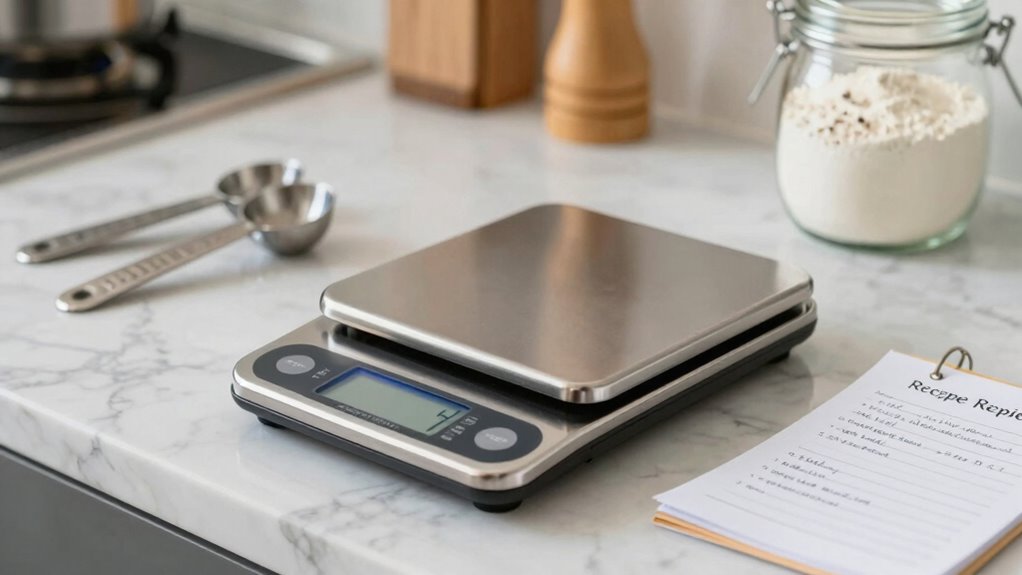

To make baking foolproof, develop five key habits with your kitchen scale. Always weigh ingredients precisely, using the tare function to reset the scale after placing containers. Calibrate your scale regularly to guarantee accuracy, and use a stable, flat surface for consistent readings. Keep your scale clean and well-maintained for longevity and precision. By mastering these habits, you’ll enjoy more reliable results, and if you keep going, you’ll discover even more tips to perfect your baking skills.
Key Takeaways
- Always tare the scale after placing a container to measure only the ingredient’s weight accurately.
- Regularly calibrate your digital scale with a standard weight to maintain precision.
- Use a flat, stable surface and avoid tilting for consistent, reliable readings.
- Weigh ingredients directly on the scale rather than using volume measurements for accuracy.
- Keep the scale clean and store it properly to prevent residue buildup and ensure long-term accuracy.
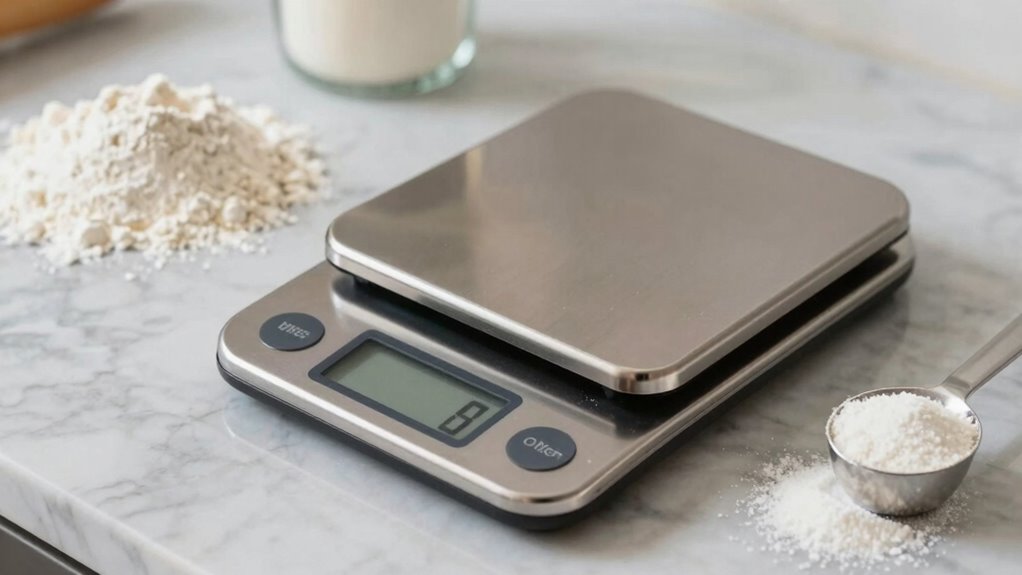
A kitchen scale is an indispensable tool that can make your cooking and baking more precise and consistent. When you’re aiming for perfect results, understanding proper measuring techniques is vital. Instead of relying on eyeballing ingredients or using volume measurements, you should always weigh your ingredients for accuracy. This means placing your bowl or container on the scale first, zeroing it out, and then adding your ingredient until you reach the exact weight called for in your recipe. This practice minimizes errors caused by ingredient variations or settling, ensuring each batch turns out just right.
To keep your measurements accurate over time, calibration practices are equally important. Many digital scales have a calibration function, which you should use periodically, especially if you notice inconsistent readings. Calibration involves using a standard weight to verify the scale’s accuracy and adjusting it if necessary. Regular calibration not only guarantees precision but also extends the lifespan of your scale. If your scale doesn’t have a calibration feature, check the manufacturer’s instructions for recommended maintenance or replacement guidelines. Proper calibration is a habit that guarantees your measurements stay reliable, no matter how often you bake or cook.
Regular calibration ensures accurate measurements and prolongs your scale’s lifespan.
Another key measuring technique is to always tare your scale after placing your container or bowl. This zeroing process ensures that only the weight of your ingredients is measured, preventing skewed results caused by the container’s weight. For example, if you’re measuring flour, place the bowl on the scale, hit the tare button, and then add flour until you reach the desired weight. This simple step makes measuring straightforward and reduces cleanup, as you don’t need to subtract container weight manually.
It’s also helpful to keep your scale on a flat, stable surface for consistent readings. Any tilting or uneven placement can lead to inaccurate measurements. Make a habit of checking the scale’s placement before each use. If your scale has a protective cover or lid, keep it on when not in use to avoid dust or debris affecting the sensor. When measuring small amounts, use the scale’s fine-tuning features if available, as they allow for more precise adjustments. Additionally, understanding the contrast ratio of your projector can help you optimize your viewing environment for a better movie night experience.
Finally, always clean your scale after use with a soft, damp cloth, especially if you’ve measured sticky or powdered ingredients. This prevents residue buildup and keeps your measurements clean and accurate. Developing these habits—proper measuring techniques and calibration practices—guarantees your baking is consistently successful. Over time, your precision and confidence will grow, making your kitchen a place where every recipe turns out perfect.
digital kitchen scale with tare function
As an affiliate, we earn on qualifying purchases.
As an affiliate, we earn on qualifying purchases.
Frequently Asked Questions
How Often Should I Calibrate My Kitchen Scale?
You should calibrate your kitchen scale regularly, ideally once a month or whenever you notice inconsistent measurements. Make sure to place the scale on a flat, stable surface for accurate readings. Check the battery and replace it if the display becomes dim or shows erratic results, as low power can affect calibration. Consistent calibration guarantees your measurements stay precise, making your baking consistently successful.
Can I Use a Digital Scale for Liquids?
Think of your digital scale like a modern-day Atlas—perfect for handling liquids. Yes, you can use it for liquid measurement, but make certain it’s calibrated correctly. Unlike mechanical scales, digital ones offer more precise readings, which is essential for liquids. Just place your container on the scale, tare it, and pour. This method ensures accuracy whether you’re measuring water, oil, or other liquids for your recipes.
What’s the Best Way to Clean a Kitchen Scale?
To clean your kitchen scale, start by turning it off and unplugging it if it’s digital. Wipe the surface gently with a damp cloth and mild soap, avoiding excess moisture to guarantee food safety. Dry thoroughly with a soft towel. For storage tips, keep it in a dry, clean place away from moisture and dust. Regular cleaning maintains accuracy and prolongs your scale’s lifespan, making baking consistently successful.
Are Mechanical Scales More Accurate Than Digital Ones?
Mechanical scales aren’t necessarily more accurate than digital ones, but they do excel in mechanical accuracy, offering consistent readings over time. Digital precision, on the other hand, often provides more detailed measurements, sometimes down to fractions of a gram. So, if you need absolute exactness, go for a digital scale. But if you prefer a trusty, straightforward tool, a mechanical scale can be just as reliable—like having a dependable sidekick in your kitchen.
How Do I Troubleshoot Inconsistent Measurements?
To troubleshoot inconsistent measurements and improve measurement accuracy, first guarantee your scale is on a flat, stable surface. Always zero the scale before weighing ingredients, and avoid overcrowding the weighing platform. Use the same type and temperature of ingredients for ingredient consistency. Regularly calibrate your scale if possible, and clean it to prevent debris from affecting readings. These habits help maintain accuracy and ensure your baked goods turn out perfectly every time.
calibrated food scale for baking
As an affiliate, we earn on qualifying purchases.
As an affiliate, we earn on qualifying purchases.
Conclusion
By adopting these five habits, you’ll turn baking into a stress-free experience. For example, consistently measuring ingredients with your kitchen scale saved Sarah from her last-minute cake flop, as she realized she’d misjudged the flour amount. Small habits like zeroing out the scale and using it for liquids can make a big difference. Keep these tips in mind, and you’ll enjoy perfectly baked treats every time—confidence that comes from precision and practice.
As an affiliate, we earn on qualifying purchases.
As an affiliate, we earn on qualifying purchases.